
Learning how to make your brand visible in AI search results is very important nowadays. More and more people are using chatbots like ChatGPT, Gemini, Claude and Perplexity of traditional search engines like Google. Think about how you search for things. When was the last time you used a chatbot to find something of looking through lots of Google links? Your potential customers are doing the thing. That is why Generative Engine Optimisation or GEO is so important.
If you have ever asked ChatGPT or Perplexity to recommend a tool in your category and your brand was not mentioned, even though you are on the page of Google you are not imagining things. Learning how to make your brand visible in AI search results is one of the important jobs in marketing today. I have spent a lot of time working on this problem. I have run GEO campaigns for B2B SaaS clients. Here is what actually works, based on campaigns and mistakes.
What Is GEO and How Is It Different from SEO?
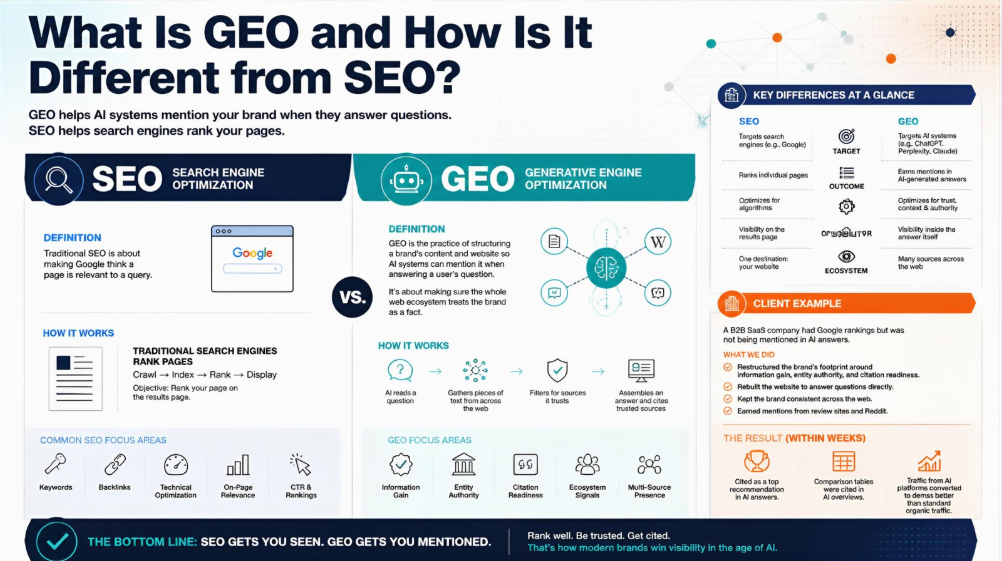
GEO is the practice of making sure your brands content and website are structured so that AI systems like ChatGPT and Perplexity mention you when answering a users question. Traditional SEO is about making sure Google thinks your page is relevant to a query. GEO is about making sure the whole web ecosystem thinks your brand is a fact.
That is a difference. Traditional search engines rank pages. Generative engines read a question find pieces of text from across the web and put them together into an answer only citing sources they trust.
One of my clients a B2B SaaS company had rankings on Google but was not mentioned in AI answers. We changed that by restructuring their footprint. We focused on three things: information gain, entity authority and citation readiness. We rebuilt their website to answer questions directly. We made sure their brand was consistent across the web. We got mentions from sources like review websites and Reddit.
Within a weeks the brand was cited as a top recommendation in Perplexity and ChatGPT Search. Their comparison tables were cited in Google AI Overviews. Traffic from AI platforms converted to demos at a rate than standard organic traffic.
The C.A.R.E. Framework: A DIY AI Search Audit
This is the framework I use to audit a brand’s AI search visibility, and you can run it across your top five landing pages in under 30 minutes.
| Phase | What to Check | Pass / Fail Criteria |
| C – Crawl & Render | robots.txt and server-side HTML | Are GPTBot, PerplexityBot, ClaudeBot, and Google-Extended allowed? Does your core text appear in the raw page source without JavaScript execution? |
| A – Answer Architecture | Information gain and extractability | Does every key H2 open with a self-contained answer (40–60 words)? Are comparisons in structured tables rather than prose? |
| R – Reputation Consensus | Third-party footprint | Do independent reviews on Reddit, G2, or Trustpilot confirm the same features your site claims? |
| E – Entity Disambiguation | Schema and knowledge mapping | Is nested JSON-LD schema live, with validated sameAs links to your official profiles? |
The 10-Minute “Money Prompt” Test
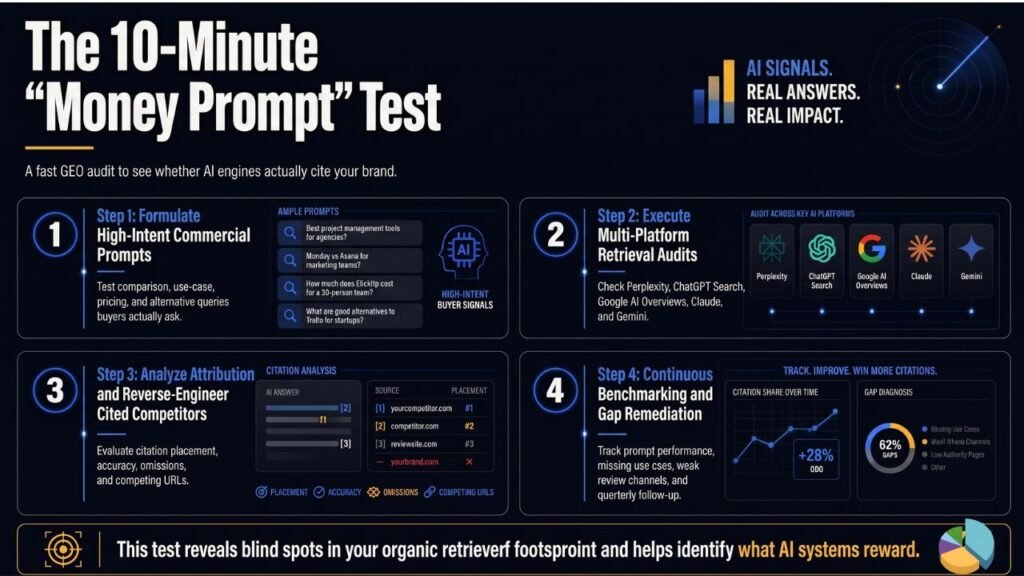
Once you have completed the technical diagnostics within the C.A.R.E. checklist, the next critical phase is learning how to make your brand visible in AI search results through an empirical audit across live environments. Running simulated queries provides immediate, ground-level feedback on how to make your brand visible in AI search results while revealing exact blind spots in your organic retrieval footprint. Theoretical optimisation only goes so far; understanding how to make your brand visible in AI search results by observing how large language models parse, synthesise, and attribute your market category in real time is what separates actionable GEO from guesswork.
Step 1: Formulate High-Intent Commercial Prompts
Begin by documenting five to ten high-intent conversational prompts that genuine prospective buyers use when evaluating software, services, or solutions. Rather than testing short-tail navigational queries, focus on deep-funnel comparative and exploratory phrasing to test how to make your brand visible in AI search results:
- Comparative Prompts: “How does [your brand] compare to [primary competitor] for enterprise workflows?”
- Use-Case Recommendations: “What are the best [category] tools for [specific workflow or business size]?”
- Feature and Pricing Inquiries: “Which [niche] platforms offer native API integrations and transparent tiered pricing?”
- Alternative Discovery: “What are the top open-source or cost-effective alternatives to [industry leader]?”
Drafting precise prompts helps evaluate how to make your brand visible in AI search results where commercial purchase intent is highest.
Step 2: Execute Multi-Platform Retrieval Audits
Take your structured prompt list and run each query systematically across major generative engines to uncover how to make your brand visible in AI search results:
- Perplexity AI: Focus on the inline numeric citations to see which specific URLs, forum threads, or review portals the model references to build its response.
- ChatGPT Search: Evaluate whether the platform synthesizes your company as a primary entity or merely aggregates third-party directory listings.
- Google AI Overviews: Observe how generative snapshots extract data from page-one organic results versus lower-ranking domains with structured data tables.
- Claude & Gemini: Test conversational summaries to see how knowledge graph associations categorize your core value proposition.
Testing multiple interfaces ensures your playbook on how to make your brand visible in AI search results accounts for differing retrieval algorithms, index refresh rates, and context window limits.
Step 3: Analyze Attribution and Reverse-Engineer Cited Competitors
Examine the synthesised output with analytical scrutiny to discover new ways regarding how to make your brand visible in AI search results:
- Check Citation Placement: Is your brand mentioned directly within the main synthesized paragraph, relegated to an obscure secondary link, or omitted entirely?
- Verify Information Accuracy: If your platform is mentioned, are the features, pricing tiers, and capabilities accurately represented, or is the model hallucinating outdated legacy information?
- Inspect Omission Root Causes: If your business is missing, inspect the domains cited in your place. In most scenarios, you will discover that language models prioritized third-party Reddit discussions, G2 comparison grids, or competitor landing pages featuring self-contained answer blocks.
Reverse-engineering cited competitor URLs provides an exact blueprint for how to make your brand visible in AI search results by highlighting the exact formats, data tables, and third-party validation points models prefer.
Step 4: Continuous Benchmarking and Gap Remediation
When a page buries core data beneath introductory fluff or lacks an authoritative web-wide reputation footprint, generative retrieval pipelines consistently favor competing domains with clearer information architecture. Document your findings in a quarterly tracking sheet to master how to make your brand visible in AI search results:
- Note which high-intent money prompts trigger direct brand citations.
- Flag missing use-cases that require dedicated answer-first comparison landing pages.
- Identify weak third-party review channels that require targeted reputation outreach.
Conducting this diagnostic quarterly ensures that as conversational algorithms evolve, your operational strategy on how to make your brand visible in AI search results remains robust, factual, and consistently cited by every major AI engine.
5 GEO Myths That Are Costing You Citations
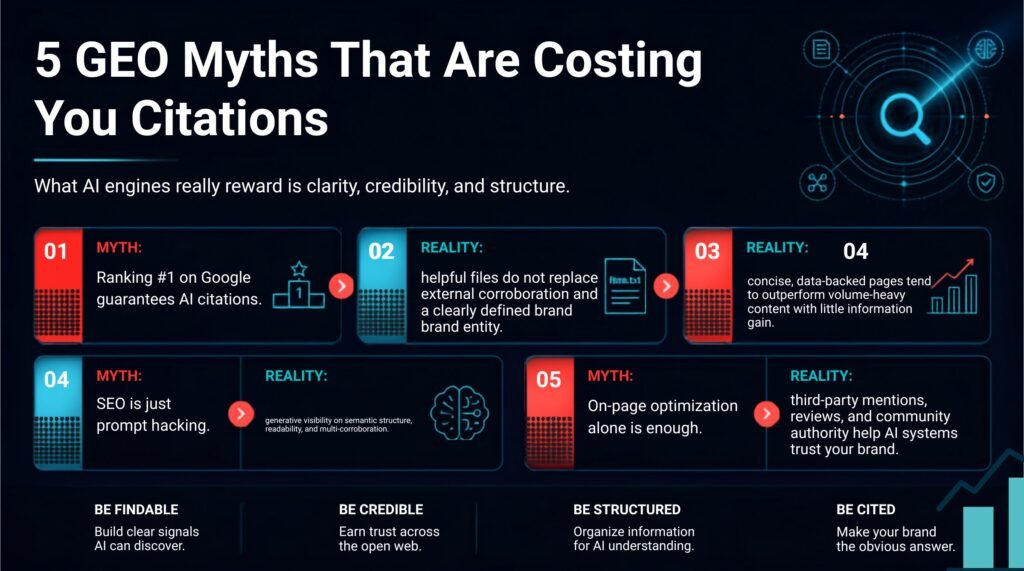
Myth 1: “If you rank #1 on Google, AI engines will automatically cite your business.”
This remains the most pervasive and expensive assumption in modern search marketing. Independent studies reveal that fewer than 30% of web sources referenced by generative platforms like ChatGPT Search and Perplexity overlap with Google’s top ten organic search positions. Traditional search algorithms prioritize backlink profiles and domain age, whereas conversational engines prioritize structured data blocks and direct factual relevance. When researching how to make your brand visible in AI search results, relying solely on legacy organic rankings will leave your business completely invisible during conversational user journeys.
Myth 2: “Uploading an llms.txt file instantly guarantees AI citations.”
An llms.txt file is a helpful technical standard for pointing web crawlers toward clean markdown files, but it does not function as an automated ranking trigger. AI retrieval systems do not blindly trust a file just because it exists in your root directory. If your brand entity remains ambiguous and lacks external corroboration across authoritative platforms, language models will ignore your documentation. Understanding how to make your brand visible in AI search results means focusing on web-wide consensus rather than relying on quick configuration shortcuts.
Myth 3: “Publishing massive volumes of content increases your citation frequency.”
Flooding a domain with generic, programmatic articles dilutes semantic authority rather than building it. Peer-reviewed research presented at KDD 2024 by teams from Princeton, Georgia Tech, and IIT Delhi demonstrated that adding verifiable statistics, empirical benchmarks, and referenced sources improves generative visibility by up to 40%. When executing strategies on how to make your brand visible in AI search results, concise and data-backed content blocks consistently outperform high-volume, surface-level articles lacking real information gain.
Myth 4: “Generative Engine Optimization is unpredictable prompt hacking.”
Generative discovery is not a mysterious black box governed by hidden tricks. LLM retrieval pipelines operate on transparent computer science principles: semantic vector similarity, server-side DOM parsing, named entity extraction, and multi-source corroboration. Learning how to make your brand visible in AI search results is strictly an information architecture discipline that requires clear technical layouts and extractable structured formats.
Myth 5: “On-page optimization alone is enough to win conversational search.”
Many practitioners mistakenly treat AI optimization as an isolated on-page exercise. Language models evaluate external brand authority by scraping independent communities like Reddit, G2, Trustpilot, and industry roundups. If your internal pages make bold marketing claims that are absent from third-party discussions, generative models will discount your domain. Establishing an authentic web-wide reputation is essential when discovering how to make your brand visible in AI search results.
Frequently Asked Questions
- Does ranking well on Google guarantee AI citations? No. Research shows the overlap between top Google results and AI-cited sources is often below 30%. Structure and third-party consensus matter more than domain authority alone.
- How long does it take to see results from GEO? In the case study above, measurable citation gains appeared within six to eight weeks, though this varies by competitive density in your category and how much third-party consensus already exists.
- Is llms.txt necessary? It can help, but it’s a minor supporting signal, not a substitute for structured content, schema, and independent reputation.
- Why is my business not appearing in ChatGPT or Perplexity search results? AI retrieval systems omit brands when content is buried behind promotional fluff, blocked by robots.txt, or lacks third-party mentions on trusted platforms like Reddit and G2. Generative engines prioritize verifiable facts over self-published marketing claims.
- What is the difference between SEO and Generative Engine Optimization (GEO)? Traditional SEO optimizes pages to rank high on search engine result pages, while GEO structures information so AI chatbots directly cite your business as a trusted entity when answering user queries.
- What role does schema markup play in AI search visibility? Nested JSON-LD schema with validated
sameAslinks helps large language models disambiguate your brand identity. It maps your official social profiles, leadership, and products into a structured knowledge graph that AI crawlers can verify effortlessly. - How does third-party consensus impact visibility in AI search results? Generative engines cross-reference on-site claims against external communities, user reviews, and industry roundups. Cultivating strong third-party reviews is essential to make your brand visible in AI search results because models favor multi-source consensus.
- Can AI-generated content help my brand get cited in AI answers? Publishing high volumes of generic AI copy often dilutes entity authority. Peer-reviewed research confirms that incorporating unique data, real-world case studies, and verified statistics is far more effective for gaining citations than merely increasing word count.
- How do I know if AI search bots are crawling my website? Inspect your server logs and
robots.txtconfiguration to ensure user agents like GPTBot, PerplexityBot, ClaudeBot, and Google-Extended are permitted and can render your core text without relying on heavy client-side JavaScript execution. - What is the quickest way to test how visible your brand is in AI search? Run high-intent money prompts—such as category comparisons and direct product queries—across ChatGPT Search, Perplexity, and Google AI Overviews. Track whether your platform is cited, check the accuracy of the summary, and audit the sources cited in place of your site.
Key Takeaways
- Differentiate Between Google Rankings and AI Citations Ranking on the first page of traditional search engines does not guarantee automated brand mentions in generative engines. Traditional SEO optimizes for link popularity and standard keyword density, whereas generative engine optimization requires extractable facts and direct information gain. Understanding how to make your brand visible in AI search results requires a distinct dual-track strategy where organic keyword visibility and conversational answer retrieval are executed as two complementary, yet fundamentally separate, marketing initiatives.
- Prioritize Third-Party Corroboration Over Self-Serving Claims Large language models do not evaluate your credibility based solely on what you publish on your internal domain. AI retrieval pipelines rely heavily on multi-source verification, extracting sentiment from independent customer reviews, Reddit discussions, and recognized industry publications. To truly master how to make your brand visible in AI search results, you must build an authentic web-wide footprint, ensuring external consensus actively validates your product capabilities and brand reliability.
- Implement an Answer-First Information Architecture Conversational models parse digital content into semantic chunks and score each segment for immediate relevance. If core takeaways are buried beneath excessive narrative fluff or marketing introductions, the retrieval algorithm discards the text block entirely. To solve how to make your brand visible in AI search results, open every major section with a self-contained 40-to-60-word answer block, explicit entity definitions, and structured comparison tables designed for direct extraction.
- Establish Explicit Entity Authority via Structured Data Generative engines rely on knowledge graphs to connect products, founders, and core features without ambiguity. Adding nested JSON-LD schema with verified sameAs properties provides direct relational context across all official digital profiles. Executing comprehensive entity disambiguation is a foundational requirement when learning how to make your brand visible in AI search results, preventing search bots from confusing your business identity with competing platforms in your market niche.
- Ensure Technical Accessibility for Generative Web Crawlers. High-value written insights provide zero citation value if AI crawler bots are restricted at the server level. Webmasters must actively audit robots.txt configurations to permit access for GPTBot, PerplexityBot, ClaudeBot, and Google-Extended. Ensuring all core educational content and factual data render cleanly in raw server-side HTML without client-side JavaScript execution is a mandatory technical standard for optimising your brand’s visibility in AI search results.
Conclusion
The digital landscape has fundamentally shifted, and learning how to make your content visible in AI search results is now essential for modern discoverability. For years, organic growth relied on a simple formula: target keywords, build backlinks, and rank on standard search pages. Today, that linear path no longer guarantees success. As decision-makers rely on conversational engines like ChatGPT, Gemini, Perplexity, and Claude for instant answers, discovering practical ways to make content visible in AI search becomes critical to avoid losing high-intent traffic.
Achieving high visibility for your content across AI search engines requires a strategic pivot toward Generative Engine Optimization (GEO). The main reason reputable businesses get overlooked in synthesized answers is poor information architecture and a lack of verified consensus. If you want to know the best way to get your content seen in AI search results, the focus must move away from generic marketing copy toward structured, extractable data. Large language models favor self-contained answer blocks, clear comparison tables, and verifiable claims corroborated by Reddit, Trustpilot, and authoritative industry roundups.
Succeeding with your content’s visibility in AI search results is not about temporary tricks or simple file uploads. It demands continuous execution. By implementing the C.A.R.E. framework, ensuring crawlers can parse server-rendered HTML, maintaining nested JSON-LD schema, and strengthening third-party reputation signals, you build the foundation needed to make your digital content visible across AI search results.
As conversational platforms capture a greater share of web discovery, understanding how to make your content visible in AI search results will separate market leaders from invisible competitors. Audit landing pages regularly, benchmark high-intent queries across major platforms, structure insights with precision, and establish your domain as an undeniable, cited authority.