
Google Search Console new updates in 2026 have changed the way we look at SEO performance. If you have logged into your dashboard recently, you have probably noticed things look quite different. The dashboards are more crowded, there is AI-flavored language everywhere, and if you are in charge of an e-commerce site or a content-heavy blog, your impression graphs might be doing things you were not expecting.
I started watching these Google Search Console updates closely in early Q1 2026 around the time Google introduced deeper AI-driven search performance metrics and improved real-time indexing insights. One of our e-commerce clients had a shift in impression data during that release. The new reporting made it much easier to see which parts of the site were adapting well to Google’s updated intent-matching algorithms and which needed attention. That visibility allowed us to change the content strategy fast, and the client got back the traffic they had lost—they ended up with more overall organic visibility a few weeks later.
This post goes through what these updates mean in practice based on that experience and a few others since rather than just repeating Google’s release notes.
Understanding the Shift in AI Performance Tracking
To effectively navigate the Google Search Console New Updates in 2026, it helps to understand why the interface feels so different. Google is no longer just reporting on simple blue-link SERP results; the system is built to evaluate generative search visibility, real-time indexing feedback, and brand authority across multiple platforms.
When reviewing data inside the Google Search Console New Updates in 2026, site owners now have access to metrics that break down how search algorithms parse conversational content. Instead of focusing purely on organic rank position, the new reporting structure highlights:
- Generative Impression Share: How frequently your site’s URLs are selected to inform AI-generated search summaries.
- AI Contextual Triggers: The precise schema markups and modular content blocks that trigger citations in conversational responses.
- Integrated Discovery Insights: Deeper tracking capabilities that connect canonical search performance with social authority and cross-platform presence.
By leveraging these new dimensions within the Google Search Console New Updates in 2026, you can quickly identify which sections of your site are generating passive visibility and adjust your content layout to convert those interactions into active website traffic.
The Metric Most People Are Reading Wrong
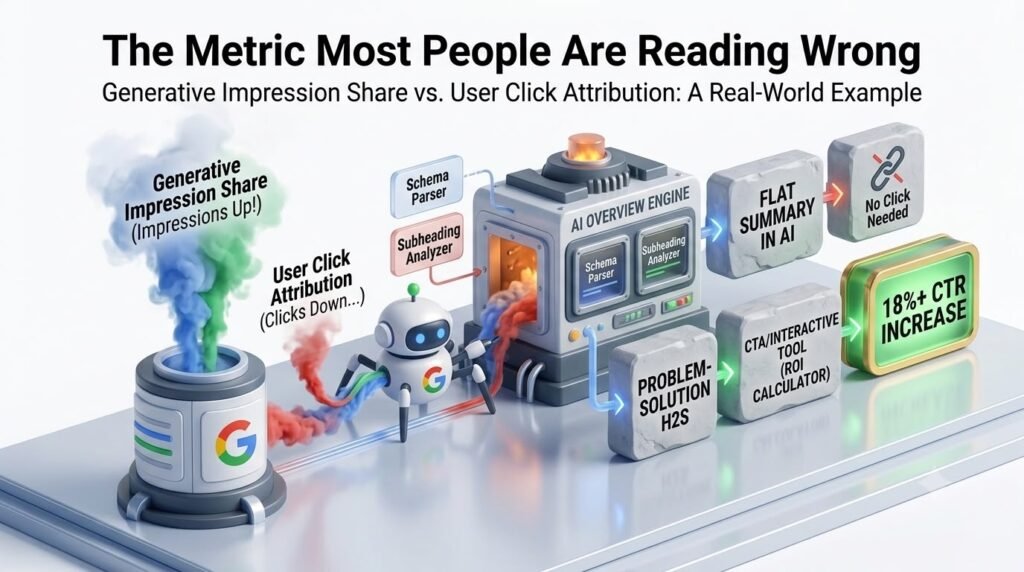
The biggest surprise in the new reporting is the difference between Generative Impression Share and User Click Attribution—and almost no one is looking at it correctly yet.
Here’s the issue. When Google’s AI pulls your content directly into an AI Overview, your impressions can go up a lot. Clicks don’t always come, because the user already has their answer. They never needed to go to your page.
Most site owners see impressions and think traffic is on the way. It usually is not—not automatically. The real chance is in looking at the AI Contextual Triggers in that report: the specific schema markup and conversational subheadings the AI is using to determine your page are worth citing. Once you know what is causing the citation, you can make your content so that being *cited* also means being *visited*.
A Real Example: Changing Citations Into Clicks
One of our blog posts was being used often in AI Overviews, but organic clicks were dropping because the AI was summarising our conclusion for the reader. There was nothing left to click on.
Here’s what we did:
1. Changed the H2S and H3s into Problem–Solution” pairs instead of flat statement headers.
2. Added a CTA right after the section most likely to be used in a featured snippet.
3. Held back the actionable takeaway—gave a high-level summary in the text, then paired it with an interactive prompt (“Calculate your specific ROI using our interactive checklist below”).
The AI still cited the page as the source. Now the citation pointed to a tool the AI couldn’t replicate inline. Users had a reason to click. That single change increased CTR from AI search by over 18% with no drop in ranking position.
GSC Social Media Property Tracking: Useful. Not Real-Time Yet
The other big addition worth mentioning is GSC Social Media Property Tracking. I have a social audience of about 45,000 followers, so this feature was one of the first things I tried.
My opinion: it’s really useful but it’s still developing.
What it does well:
- Links search data and social profile authority in one place at a time.
- Offers good signal on how social brand searches contribute to canonical discoverability.
- Works as a solid starting point for measuring organic health across platforms.
What it doesn’t do well:
- Tracking for short-form video spikes and fast engagement has delays.
- It’s not made for real-time campaign monitoring—you’ll still need your platform’s analytics for that.
- We use it as a support, not a substitute. It’s the view; your platform dashboards are still the close-up.
The Mistake Almost Everyone Is Making NowThe Mistake Almost Everyone Is Making Now
With this much change coming into Search Console all at once, the most common response I see across the industry is pure panic.
When creators and site owners log into their dashboards and spot a sudden dip in standard Click-Through Rates (CTR) or a dramatic surge in total impressions, their immediate instinct is to panic-edit. Within 48 hours of noticing these fluctuations, they start completely rewriting pages that were previously performing well, changing title tags, or overhauling their entire site architecture. That is almost always the wrong move.
A lot of what looks like a traffic loss is actually Google running real-time algorithmic tests and refining how data is recorded across generative features. Reacting to short-term numbers without understanding the context behind the Google Search Console new updates in 2026 usually inflicts more harm on your search performance than the actual update itself.
What to Do Instead: A Strategic Action Plan
- Combine Platform Analytics for Holistic Insights: Utilize new cross-platform features like Social Media Property Tracking alongside your native channel analytics to get a comprehensive view of overall brand authority and canonical discoverability.
- Avoid Knee-Jerk Content Rewrites: Do not rewrite or modify well-ranking content every time impressions or clicks fluctuate day to day. Algorithm adjustments under the Google Search Console new updates in 2026 require testing periods, so short-term data spikes or drops are completely normal.
- Optimize for User Intent and Modular Structure: Shift your content strategy toward clear answer blocks, structured schema markup, and well-defined subheadings. Ensuring your content directly addresses conversational search queries makes it far easier for Google to cite your site properly.
- Allow Data to Settle Before Taking Action: Give Google at least 2 to 3 weeks to re-index your updated pages and allow reporting data to stabilize. Analyzing long-term performance trends is far more reliable than making hasty edits based on single-day metrics in the Google Search Console new updates in 2026.
- Focus on Conversions Over Impression Noise: Stop evaluating SEO success solely based on raw impression counts. Focus your analysis on high-intent user engagement, direct tool interactions, and lead conversions that deliver tangible business value.
- Analyze AI Contextual Triggers Carefully: Instead of worrying about zero-click searches, review the specific contextual triggers and snippet formats that Google uses to source your content. Use these insights to craft unique value propositions—like interactive checklists or specialized tools—that encourage users to click through for the full experience.
Quick Comparison: Old GSC Reporting vs. 2026 Updates
The move from Google Search Console (GSC) reporting to the 2026 changes represents a major change in how search optimisation works. While the older GSC was mainly made to track blue-link search behaviour, the new 2026 system gives important information about how current AI search systems look at, store and describe website content.
Here is a quick strategic comparison between the features and the new 2026 improvements:
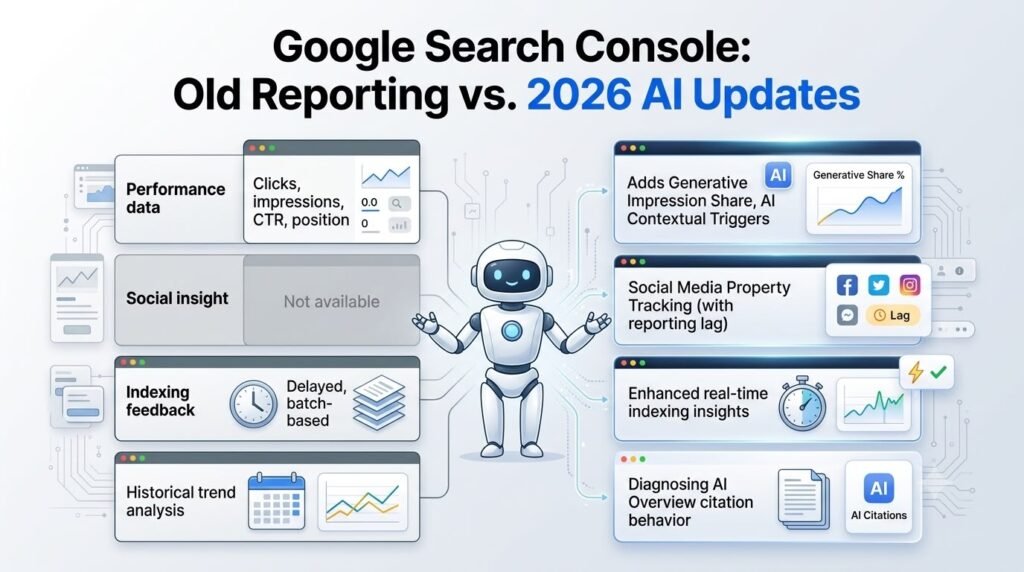
Performance Data Metrics:
- Legacy GSC: Concentrated on normal engagement numbers like total clicks, views, average CTR and standard organic rankings.
- 2026 Updates: Adds more visibility by bringing in Generative Impression Share and AI Contextual Triggers, letting search experts see exactly how and where their content is used in AI-generated answers.
Social Media Insight & Attribution:
- Legacy GSC: Did not have built-in support for media platforms.
- 2026 Updates: Includes Social Media Property Tracking, helping creators and brands with channels check how easy it is to find their content through search and social media (but there is some delay in reports during big traffic surges).
Indexing Feedback Capabilities:
- Legacy GSC: Used batch-based crawling and indexing updates.
- 2026 Updates: Provides better real-time indexing information, allowing technical SEOs to find crawl problems and index updates as they happen.
- 2026 Updates: Designed for checking how AI summaries cite websites in real time, helping marketers improve content structures to turn zero-click AI summaries into actual website visits.
Primary Practical Use Case:
- Legacy GSC: For looking at past trends and long-term keyword results.
- 2026 Updates: Designed for checking how AI summaries cite websites in real time, helping marketers improve content structures to turn zero-click AI summaries into actual website visits.
FAQs
1. Do the Google Search Console New Updates in 2026 replace the need for platform-native social analytics?
No, they complement each other rather than replacing one another. While the Google Search Console New Updates in 2026 introduced built-in Social Media Property Tracking to show how social presence impacts organic discoverability, there is still a slight reporting delay during high-traffic video spikes. You should use GSC for macro-level brand visibility and rely on native social dashboards for real-time campaign performance.
2. Should I rewrite my content immediately if impressions spike after the Google Search Console New Updates in 2026?
Not right away. An impression spike without a matching increase in clicks usually means your site is being cited in zero-click AI Overviews. Before making drastic edits, review your AI Contextual Triggers provided by the Google Search Console New Updates in 2026. Adjust your content structure carefully to turn those citations into visits instead of making knee-jerk changes based on short-term data.
3. How do the Google Search Console New Updates in 2026 help in turning zero-click AI summaries into actual website traffic?
The Google Search Console New Updates in 2026 offer clearer visibility into Generative Impression Share and User Click Attribution. By analyzing these specific metrics, publishers can restructure high-performing content with Problem-Solution headers, structured schema, and interactive call-to-actions (CTAs) that incentivize users to click through for complete details.
4. How long should I wait before evaluating post-performance under the Google Search Console New Updates in 2026?
It is best to wait at least 1 to 2 weeks after making content or structural changes. Because search algorithms continuously run tests and adjust data processing under the Google Search Console New Updates in 2026, reacting to short-term data fluctuations can cause more harm than good. Give the metrics time to settle before measuring results.
5. What is the biggest mistake site owners make with the Google Search Console New Updates in 2026?
The most common mistake is panicking over sudden shifts in traditional Click-Through Rates (CTR). Many site owners react to short-term algorithmic testing by unnecessarily rewriting pages that were already performing well. Understanding how to interpret the new AI performance metrics introduced in the Google Search Console New Updates in 2026 prevents unnecessary and risky site overhauls.
Key Takeaways: Mastering Google Search Console New Updates in 2026
Understand the AI Metrics Shift: High impression spikes in AI Overviews do not automatically translate to website traffic; mastering the balance between Generative Impression Share and User Click Attribution is crucial under the Google Search Console New Updates in 2026.
Optimize for Contextual AI Triggers: Restructure high-performing content using structured schema and Problem-Solution headers to ensure AI citations lead directly to click-throughs following the Google Search Console New Updates in 2026.
Convert Zero-Click Summaries into Visits: Add interactive tools, checklists, and clear calls-to-action (CTAs) immediately after snippet-friendly sections to monetize traffic opportunities created by Google Search Console New Updates in 2026.
Leverage Cross-Platform Analytics: Use the newly introduced Social Media Property Tracking to understand how social search authority feeds canonical discoverability, a core feature introduced in the Google Search Console New Updates in 2026.
Differentiate Macro vs. Micro Data: Treat GSC social media insights as a high-level authority guide rather than a real-time campaign tracker while adapting to the Google Search Console New Updates in 2026.
Avoid Immediate Panic-Editing: Resist rewriting functional, high-ranking pages during initial impression drops; algorithm testing periods require patience when analyzing data from Google Search Console New Updates in 2026.
Prioritize Real-Time Indexing Feedback: Utilize improved real-time indexing capabilities to spot technical crawl issues and index updates immediately as part of the technical workflow for Google Search Console New Updates in 2026.
Focus on Conversion Metrics Over Noise: Shift your core SEO focus from raw impression growth to actual user intent, high-converting keyword patterns, and content engagement refined by Google Search Console New Updates in 2026.
Adapt Content Layouts for Intent Matching: Align your blog subheadings and structured answer blocks directly with conversational search queries to gain maximum visibility through Google Search Console New Updates in 2026.
Build Long-Term Algorithmic Resilience: Give search engine algorithms a few weeks to settle data after updates before executing major content overhauls, ensuring steady long-term growth with Google Search Console New Updates in 2026.
Conclusion: Adapting Your SEO Strategy for 2026 and Beyond
Navigating the Google Search Console New Updates in 2026 might feel overwhelming at first, with impression numbers changing and AI Overviews changing how users read content. However, these changes are not meant to hurt content creators—they are meant to give a clearer picture of how modern AI-driven search algorithms look at and show your site.
The biggest mistake you can make right now is getting worried about short-term numbers or making big changes to your whole site without giving the algorithms time to adjust. Instead, use the power of these Google Search Console New Updates in 2026 by focusing on actionable insights: look at your Generative Impression Share, make your structured schema better for AI Contextual Triggers, and improve your content layout to turn passive zero-click mentions into real visits to your website.
To thrive under the Google Search Console New Updates in 2026, content strategies must balance algorithmic efficiency with genuine user value. Search is always changing from blue-link listings to conversations and smart discovery. Building long-term topical authority, optimizing for conversational search queries, and constantly measuring audience engagement over raw impression metrics will ensure your site remains competitive in search engine results pages.
Furthermore, success with the Google Search Console New Updates in 2026 requires moving away from vanity metrics. Instead of obsessing over daily CTR dips, focus on how well your content satisfies multi-modal search intent and triggers rich citations. Integrating these insights with your cross-platform strategy ensures that your overall digital presence grows even as zero-click searches become more prevalent across all industries.
Additionally, adapting to the Google Search Console New Updates in 2026 involves restructuring your published posts to provide instant, high-value answers that AI bots cannot fully replicate within an inline snippet. Adding interactive elements, proprietary assets, downloadable guides, and clear call-to-actions directly below key summary points gives readers a compelling reason to leave the search overview and visit your site directly.
By being patient, making choices based on data instead of confusing numbers, and making sure your content matches what people really want, you can easily use these new reporting features in the Google Search Console New Updates in 2026 to get a big advantage for your brand. Sustainable search visibility requires a long-term commitment to quality content, structured technical performance, and continuous adaptation to changing discovery platforms.