
To Make Your Content Work with AI Search in 2026
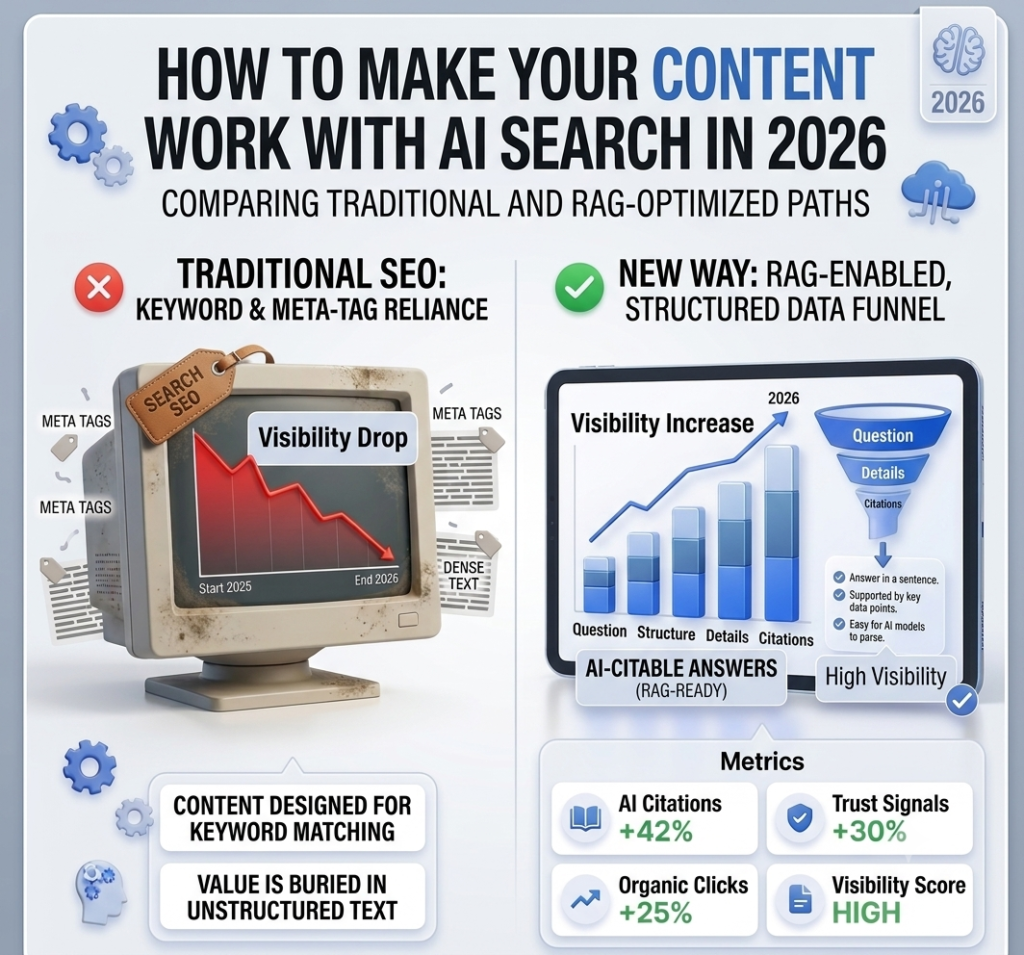
To Make Your Content Work with AI Search in 2026,If your website traffic feels different lately even though your rankings haven’t moved much, you are not imagining things. AI search optimisation is becoming the key to getting your content read and cited, yet most businesses are still writing for search engines that do no longer work the way they used to. Here is the short version: to make your content work with AI search in 2026, answer the core question in a single sentence and support that answer with a structure that’s easy to scan. This can include things like: Do not start with an introduction that’s full of keywords. This one change is the foundation of everything in this guide to AI search optimization. I will walk you through how we apply it, where it has worked, where it has failed, and the framework we use to make it work every time. Why the Old Way of Writing for Search Engines Does Not Work for AI Search AI models, whether they are an overview, a chatbot, or a retrieval-based assistant, are built to find answers to questions. They do not reward you for building suspense. Here is the difference in practice: The second version gives AI models something they can immediately extract, summarize, and attribute. The first one buries the answer under words. If you only change one thing about how you write, change this. An Example: How This Worked for Our Clients This is not an idea. We have seen it work in life. We recently applied this approach for a marketing client and a regional entertainment hub. What we changed: we rewrote the top of each service page as a “Question + Bold Direct Answer” block, followed immediately by three to four bullet points breaking down the deliverables. What happened: Within a week, Google’s AI Overviews started pulling those text blocks as citations. This increase in visibility translated into a spike in traffic. Not because we ranked higher, but because we were the source that AI tools chose to quote. This result is what convinced us that this is not a tactic. A new way of building content. The Framework We Use: The RAG-Ready Funnel To make this work for every piece of content, we run everything through a four-step process called the RAG-Ready Funnel. It is built to make content instantly scannable for both AI models and human readers. 1. The Direct Hook (Q&A Loop): answer the question in a sentence. No build-up. This gives AI models an answer. 2. The Core Data Stack: unpack details with bullet points or a Markdown table below the answer. This makes it easy for AI engines to parse for snippets. 3. Context & Nuance: add one to two paragraphs on the “why”. This adds expert insight and real depth beyond the answer. 4. Citation Triggers: link stats, names, or brand details to sources. This signals trustworthiness that AI models can cite. If you follow this structure, you will get an answer that AI models can lift cleanly while still leaving room for the expertise and context that make your content worth reading. Common Mistakes That Hurt AI Search Visibility The biggest mistake we see is businesses treating AI search like traditional search engine optimization and hiding the core value behind unnecessary words when trying to make your content work with AI search in 2026. Marketers keep writing slow-building introductions just to work in a keyword, assuming it builds authority. However, AI models do not want that long route; they want the destination immediately if you truly want to make your content work with AI search in 2026. Two specific errors show up again and again: Where This Approach Does Not Work AI search optimization is not a fix for poor-quality content. It is a way to make good content work better. It also has a limitation: knowing when to apply it. This structured approach does not work well for storytelling content. If you are writing an opinion piece, a long-form feature story, or narrative copy, forcing it into a Q&A block or bulleted stack kills the element. AI search engines are built to find answers to problems. They struggle to summarize expression or subjective nuance. They should not be asked to. The takeaway: Use this framework for the parts of your content that are built to answer a question. Keep the parts that are built to connect with a reader human, engaging, and unstructured. FAQ Does optimizing for AI search hurt traditional search engine optimization if you want to make your content work with AI search in 2026? No, optimising your website for AI search engines actually complements and enhances your traditional SEO efforts. A clear and direct answer structure tends to help both algorithms and users. Featured snippets, generative engines, and AI citations heavily reward the structure and clarity that human readers respond to, making it essential to make your content work with AI search in 2026 without losing your organic rankings. How long should the direct answer block be for maximum AI visibility? One to two concise sentences are usually enough to satisfy the immediate query. The ultimate goal is to provide a standalone, definitive answer that AI models and Large Language Models (LLMs) can easily lift and cite without needing the rest of the surrounding paragraph for context when you try to make your content work with AI search in 2026. Should every single page on your website follow the RAG-Ready Funnel? No, not every page requires it. Core service pages, in-depth how-to guides, and detailed comparison pages benefit the most from this structured approach. Meanwhile, creative narratives, personal blog posts, or opinion-driven content should keep their natural flow instead, even as you make your content work with AI search in 2026. Key Takeaways Optimising your content for AI search comes down to one core idea: answer first, then earn the depth as you make your content work with AI search in 2026. To recap: